Routes
Daily Stages on the Map
Due to various circumstances I ended up planning a hiking trip for mid‑May. Generally this time of year is considered unsuitable for fell hiking — the “rospuutto” season — when skiing is no longer possible and walking is not yet feasible, the softened snow collapses underfoot, and meltwater floods the streams. Tourists are not expected to head into the mountains then, and STF mountain huts close already at the end of April. However, based on earlier trips I knew that in the high fells, especially on slopes, the snow might still carry. Spring had also progressed slowly this year. The Abisko Alps offered a familiar area where I could experiment with hiking during this unusual season — a sort of practice run for winter trekking.
Thursday 15 May 2025. Packed the gear and started driving at 17:34, refuelled and bought snacks in Ii, reached Kolari around 21:30, refuelled again, overnight stay.
Abisko Turist – Nissonvaggi
Friday 16 May 2025. Wake‑up at 06:30, driving at 07:06 via Pajala, Svappavaara and Kiruna to Abisko, arriving at the Abisko Turist railway station parking area around 10:30. Weather partly cloudy, +5°C, a bit of wind. I repacked the backpack, filled the bottle with lemon‑flavoured sparkling water since streams might not appear immediately. I then noticed that I had forgotten my cup at home, so I cut the bottom off a 0.5 L soda bottle as a substitute. The pack was now quite heavy, over 25 kg — naturally including my homemade summer‑touring skis, 3.640 kg. Some people use a pulk for winter trips, but I don’t have one. In addition to the downhill‑oriented summer skis, I had also brought proper skis just in case, since I didn’t know what the snow conditions would be below the high fells. Looking at the birch forest next to the parking area, there was still plenty of snow. So I took out my old wooden Swedish army surplus skis (bought back in the markka era), now fitted with OAC EA 2.0 bindings. I equipped them with full‑length climbing skins for uphill use.
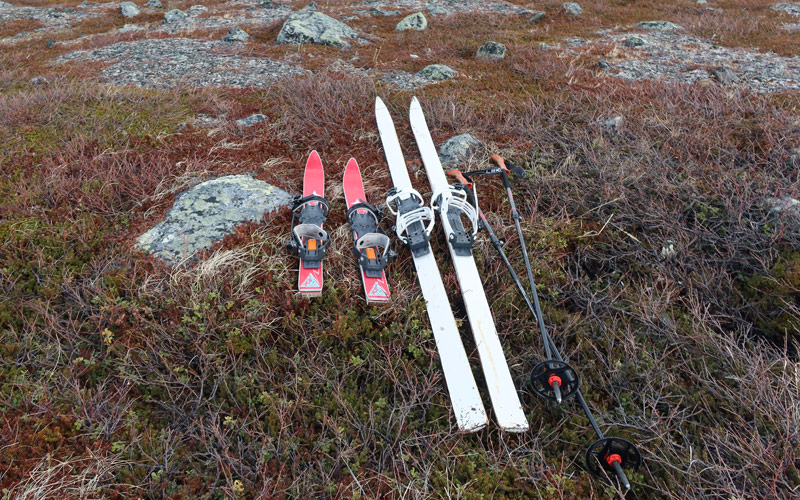
I carried the skis and poles by hand at first along the Paddus nature trail. I knew the trail ran over dry ground, so there should be no surprise flooding. Soon the snow cover became continuous and I could start skiing; the snow carried well on the trail. I progressed slowly, then from a trail junction continued past Bajip Njáhkájávrre toward the unmarked path to Nissongorsa. This path had not been used during winter and was not marked in the terrain. I skied for a while on the lake ice, then waded through deep, collapsing snow in the birch forest for over a kilometre until I reached a stream flowing from a small pond. There was a bridge over the stream, and a well‑used snowmobile track crossed it. I drank from the stream and moved onto the snowmobile track, where the snow carried well. I followed the track upward toward the fells. Soon I reached the last stream before Nissonvaggi and filled my 4‑litre water bag, in case there would be no water higher up. I skied a bit further; occasionally there were snow‑free patches. Then the snow seemed to end entirely, so I removed the skis. Carrying them uphill with the heavy load was too much, so I left the skis there and continued on foot. I figured that in the high fells the snow would carry well and the summer‑touring skis would be enough.
After a couple of kilometres there was snow again, but it did not support walking. Up here it was sunnier and the snow had softened. I put on the summer‑touring skis, but still sank in. I trudged forward until I reached a fresh snowmobile track, which I followed until I arrived at the reindeer herder’s hut.
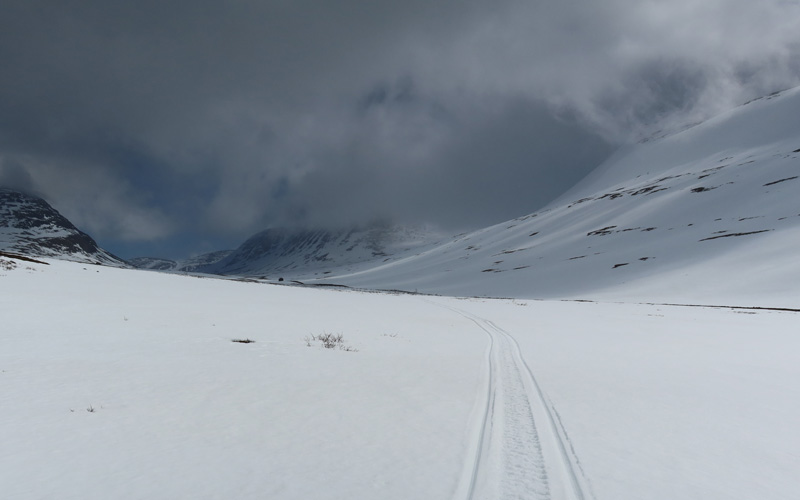
I sat on the hut’s steps for a break and to fix a misbehaving ski binding. Soon a reindeer herder arrived from the south on a snowmobile and stopped. We talked about various things, the most relevant being the current snow load‑bearing capacity relative to the length of my summer skis, and the strong winds forecast for the evening. Since I could see that the only wind‑sheltered spot in the valley was the ridge where the hut stood, I asked whether I could pitch my tent below the ridge. She said yes. Soon her husband arrived by snowmobile as well, and we discussed the length of my skis and how they were unsuitable for the fells. He considered my trip rather adventurous. He also said the wind would increase and recommended digging proper shelter for the tent. Then the couple headed toward Abisko.
I already knew that winter trekking requires a shovel, so I had bought a car shovel from Motonet and carried it here to Nissonvaggi. I dug a tent‑shaped pit in the snow and tamped the floor firm; the tent is small enough that digging was quick. I spread the tent out in the wind, anchored the windward end, inserted the pole, then secured the other end and the sides. In deep snow normal tent stakes would not work, but I had prepared for this: I had sawn ten 40‑cm pieces from a narrow wooden trim strip. These worked excellently as snow stakes and I secured the tent well. Then I built a high snow wall for wind protection — I figured seasoned outdoor people like reindeer herders wouldn’t warn about “a bit of wind.”
At 17:54 (Swedish time) I entered the tent. I had travelled 11.9 km with 585 m of ascent. The tent was again the Akto; sleeping pads were an Artiach Light Plus foam mat and a Thermarest NeoAir Xlite NXT LW air pad; sleeping bag a three‑season down bag, 960 g. The tent is cramped — the pack and boots had to stay outside.
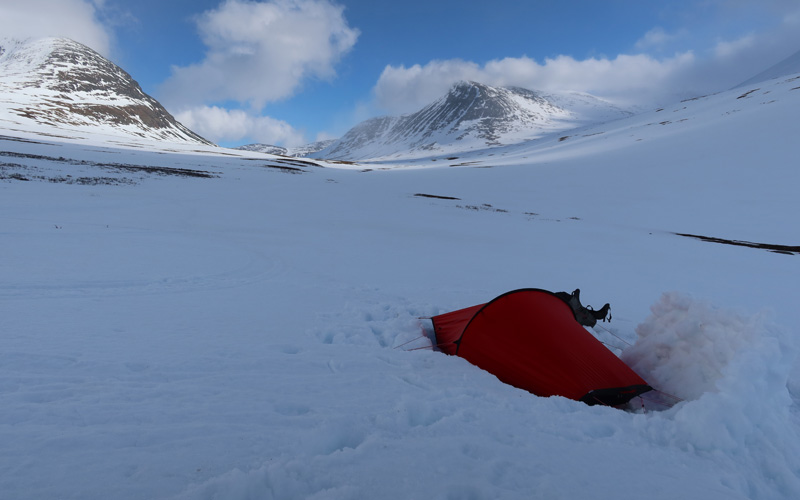
I drank from the bottle and prepared a Reiter meal. Mid‑meal I suddenly had strong heartburn and gagging; the usually tolerable Reiter chicken and noodles hot pot became inedible and I had to stop — the first half nearly came back up. I realised the symptoms were caused by the lemon soda I had drunk earlier; it was so acidic that my stomach rebelled. The drink was ironically named “light feeling.” After a while the symptoms passed. I made cocoa (luckily I still had water) and ate a chocolate bar and biscuits. Later I finished the Reiter meal as well. I improved the wind wall and inspected the surroundings. Snow was everywhere and did not carry well with short skis, let alone on foot. Would I be able to move at all, or would this trip turn into pure camping? I made more cocoa and ate more chocolate and biscuits. I went to sleep at 22:15 wearing base layers, fleece trousers and a down jacket — I stayed warm.
Day trip to Gaskariehppi
Saturday 17 May 2025. During the night it was cold and somewhat windy, though the wall sheltered the tent well. I woke at 07:12 to sunny weather and frost. Outside the snow had hardened. For breakfast I ate the rest of yesterday’s Reiter meal (a 250 g bag provides both dinner and breakfast). I made coffee and ate biscuits; water was running low.
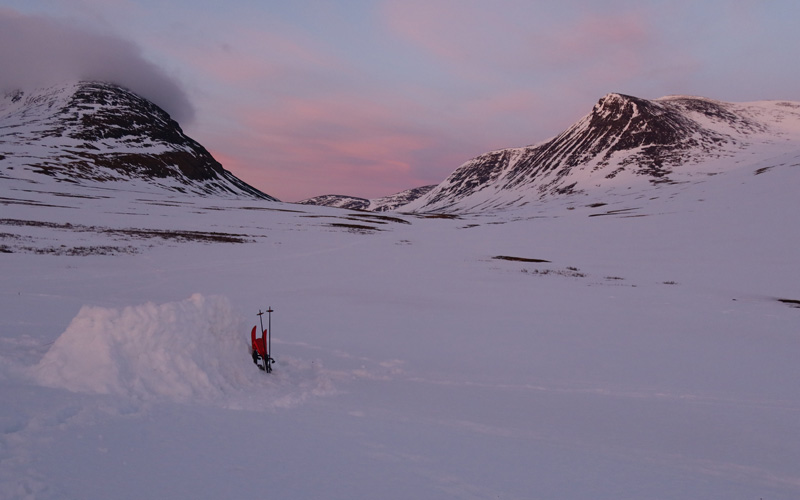
I decided to fetch the long skis from where I had left them — 4.30 km away according to the GPS. I put on the summer‑touring skis and around 09:00 began climbing the slope diagonally upward. I assumed there would be more snow there, since the reindeer herders had travelled that way by snowmobile. I soon reached their tracks and followed them upward. Higher up I found a gentler, shelf‑like section along the valley wall, with continuous snow for over two kilometres. On the hard crust the summer skis worked well and I progressed easily with double‑poling on the slightly descending shelf. At the end there was a steeper descent, which I traversed sideways. Then the snow ended; I carried the skis downhill for about a kilometre. I looked for streams to refill water, but found none. I reached the long skis, left the summer skis there, carried the long skis back to the snowline, climbed to the shelf, removed the skins and skied calmly for a couple of kilometres. Finally I descended diagonally back to the tent. The trip was 9.25 km with 373 m ascent.
At the tent I made coffee‑cocoa and ate a chocolate bar and biscuits. Water was now gone and I needed more. The landscape was entirely snow‑covered; no streams visible. I could melt snow, but doing so in the cramped vestibule would be tedious. A short distance downhill from the tent I noticed a greenish‑blue patch on the snow. From earlier trips I knew that such patches may indicate water beneath. I dug a small pit with the shovel — it filled with water quickly. I filled the water bag and bottle. Problem solved; in the sun the snow would melt and the pit would refill. I then went skiing again, climbing the western slope of Nissonvaggi diagonally upward to Gaskariehppi and the 1131 m lake where I had camped in 2023. It was windy up there. I ate a chocolate bar. I didn’t have the energy to climb to the summit, so I took some photos and turned back.
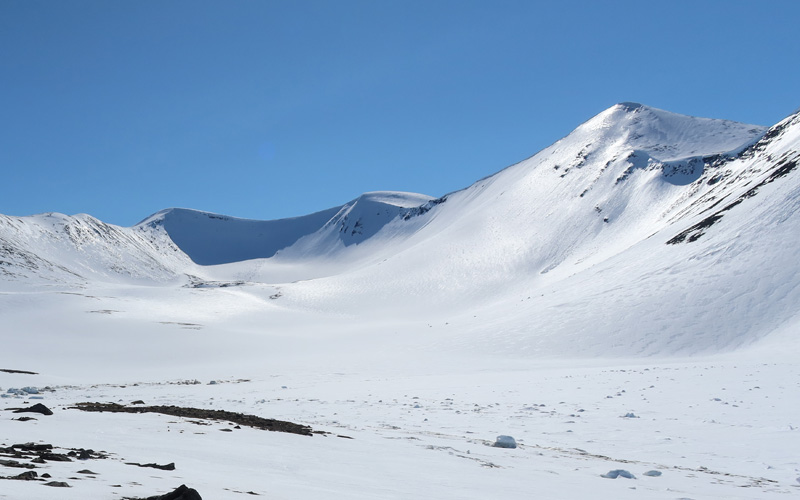
The return to the tent was all downhill; in the steeper part I made a few turns, otherwise I just let the skis glide. The ski loop was 7.51 km with 315 m ascent. I filled the bottle at the water pit. Soon the reindeer herders drove past again toward Abisko and waved. Back at the tent I prepared a Reiter pasta with beef and pepper sauce meal. The evening was calm; the sun shone through a few clouds. I considered the performance of my skis — they cannot descend steep slopes because they don’t turn quickly enough. The hard crust also wears down the wooden edges quickly. With climbing skins I could ascend steep slopes, but then I would have to walk down. The summer skis would be too risky on steep hard snow. Proper alpine skis and sturdy boots would be needed. I checked the GPS weather forecast: sunshine tomorrow and the next day, then 100% rain and +2°C, then a couple of days of frost and snowfall, and only after that sunshine again. I decided to ski here one more day and then leave. In such a small tent, days of rain or snow would not be pleasant.
Day trip to Guhkesriehppi
Sunday 18 May 2025. The night was somewhat cold — frost — and the air pad had little air. I woke at 07:15; the night had been windless, so the tent had condensation. Outside the sun was shining; I took the sleeping bag out to dry. I prepared a Reiter meal and coffee with biscuits. At the water pit a thin layer of ice had formed, but there was still water underneath. I filled the bottle. I emptied the pack and repacked only the essentials for the ski trip: down jacket, water bag, climbing skins, duct tape, cord, multitool. In the jacket pockets I put shell mitts, the improvised cup and a buff. I carried the water bottle under the jacket and attached the camera and GPS to the chest strap. Then I set off skiing again.
I skied gently upward toward Gaskariehppi. Lower in the valley the reindeer herders passed by on snowmobiles, waving good morning. They were herding reindeer that were trying to climb into Nissonvaggi from the south. According to them this was undesirable because the valley still had too much snow and too little food.
While skiing I felt energetic and wondered whether I could climb from Gaskariehppi to the ridge — over 400 m of ascent — and another 100 m to the summit. I decided I would summit today. But higher up the wind was strong enough to change my mind. Instead of summiting I decided to head to Guhkesriehppi, where I had never been — only glimpsed it from the 1792 m summit in 2023. I continued skiing, trying to maintain elevation; I had to descend slightly to avoid a steep rocky slope. After bypassing the steepest parts I began climbing diagonally toward Guhkesriehppi. The initial slope was steeper, then it eased and became almost flat. I could see the entire valley up to the 1792 m summit. A wind‑formed snow ridge was visible on the glacier at the valley head. The landscape was snowy and extremely barren. It was windy here too, from the front‑right. I took a break and ate a chocolate bar. Skiing on the flat was easy, so I continued.
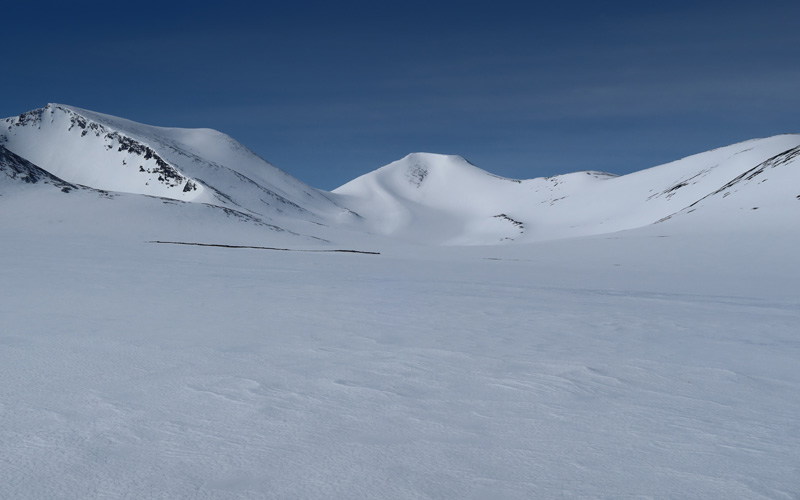
The sun shone from the south; a halo was visible around it — thin high clouds had formed. I recognised this from the 2007 and 2018 trips — a sign of worsening weather. I continued skiing; near the glacier the wind was stronger and blew directly against me, carrying snow. The drifting snow stuck to the ski bases. The slope alternated between dry drifting snow and icy patches. I climbed a bit beside the glacier until I reached a larger rock that offered shelter. I removed the skis and sat behind the rock. I scraped the snow off the ski bases and placed them base‑up to dry in the sun. The wind tried to take them, so I had to watch them. I ate a chocolate bar. Then I began the return. Descending was difficult because glide varied — sometimes the skis stuck in dry snow, sometimes they accelerated too much on ice. Once on gentler terrain, skiing with a tailwind was easy. Soon I reached Nissonvaggi and followed the snowmobile track. The sky now showed weather‑change cloud formations. I found a meltwater pool on the ridge and filled the bottle. I skied back to the tent. The day’s trip was 21.6 km with 762 m ascent.
It was windy at the tent again. The wind wall had partially melted in the sun, so I repaired it. I dried socks and boots while sitting in the sun sheltered by the hut steps. I sent messages via GPS. I went to the tent to eat a Reiter pasta with beef and pepper sauce meal. The wind and sun broke the wall again, so I repaired it. The wind had shifted from north‑northwest to more westerly, so I extended the wall along the tent’s side and raised it.
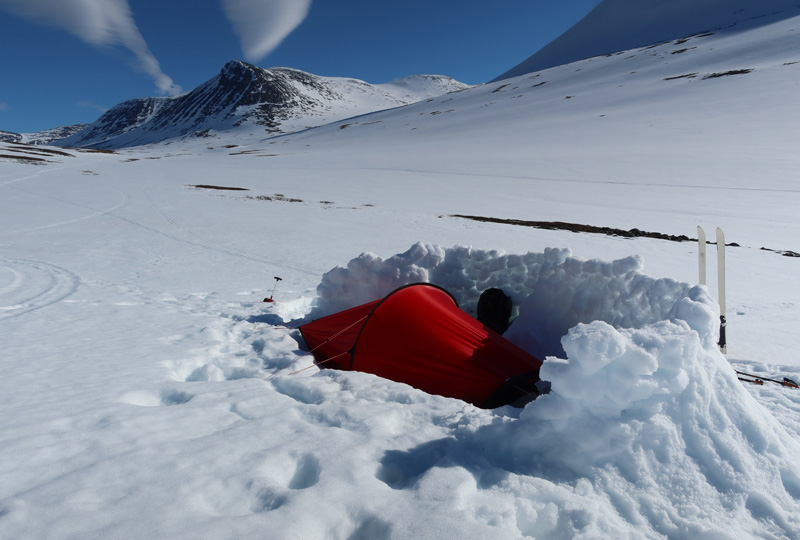
Of course the wind then calmed down — building a wind wall is an excellent way to make the wind subside. Around 18:41 I was finally able to settle into the tent; it was necessary to rest and gather strength for the return journey the next day. There was no hurry — I would have the whole day, and darkness would not be a concern, as here in the north the sun hardly set at all anymore.
Nissonvaggi – Abisko Turist
Monday 19 May 2025. I woke up around 05:00. The night had been rather windy, but thanks to the wind wall it was barely noticeable inside the tent, and it hadn’t been cold. The weather was now partly cloudy. I ate a Reiter breakfast, then brewed coffee and ate biscuits and a chocolate bar. I packed my things into the backpack and finally took down the tent. I had already attached the climbing skins to the skis the previous evening, and at 08:05 I began climbing the slope toward the shelf on the eastern side of Nissonvaggi. Then I skied across the flat section and finally descended until the snow ended. The climbing skins slowed the descent just enough so that I didn’t gain too much speed. I took the skis off and walked a little over a kilometre until I reached the summer‑touring skis. I strapped them to the side of the pack, carried the long skis to where the snow began again, fetched the backpack, then put the skis on and skied where there was snow — and walked with skis on my feet where there wasn’t. I eventually reached the snowmobile track and decided to follow it rather than head through deep snow toward Bajip Njáhkájávrre. There was snow on almost the entire snowmobile track, only a few marshy spots were bare. I reached the marked snowmobile route and followed it, then skied along the Paddus nature trail.
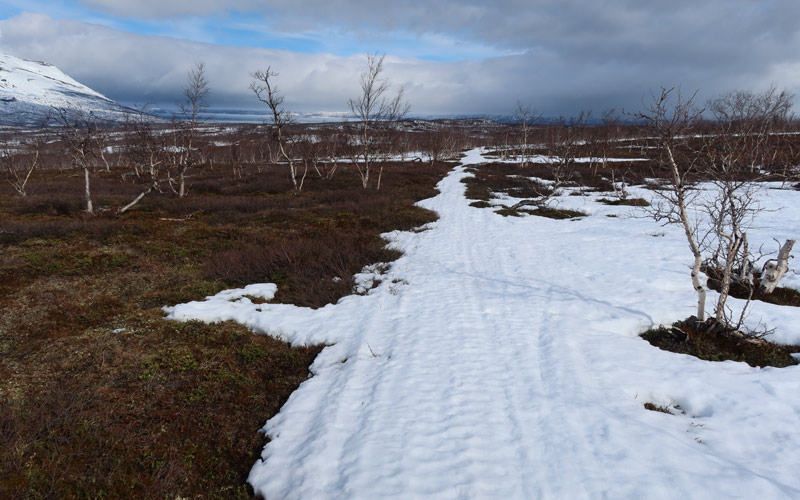
At the end I carried the skis again for a few hundred metres. During the late morning the weather became more cloudy, and dark clouds were approaching from the west. I reached the car at 12:22. The return distance was 12.9 km with 163 m of ascent and 628 m of descent. During this return day it became clear that the Lundhags hiking boots I was wearing are not suitable for skiing — both big toes developed blisters at the base on the top side of the foot. I changed clothes and drove home.
Notes: Skis are an essential part of winter trekking; in the fells it is best to have proper touring skis. Footwear should also be suitable for skiing. With proper equipment, skiing on the supportive spring snow of the high fells in sunshine is a very pleasant way to travel. For summit attempts on icy slopes, some kind of crampons that attach to boots could be useful. A larger tent with a proper vestibule would be more comfortable. Then one would already need a pulk for transporting gear. The snow shovel should be durable.